

Research Suggests Unrestricted Device Access Correlates with Lower Academic Performance
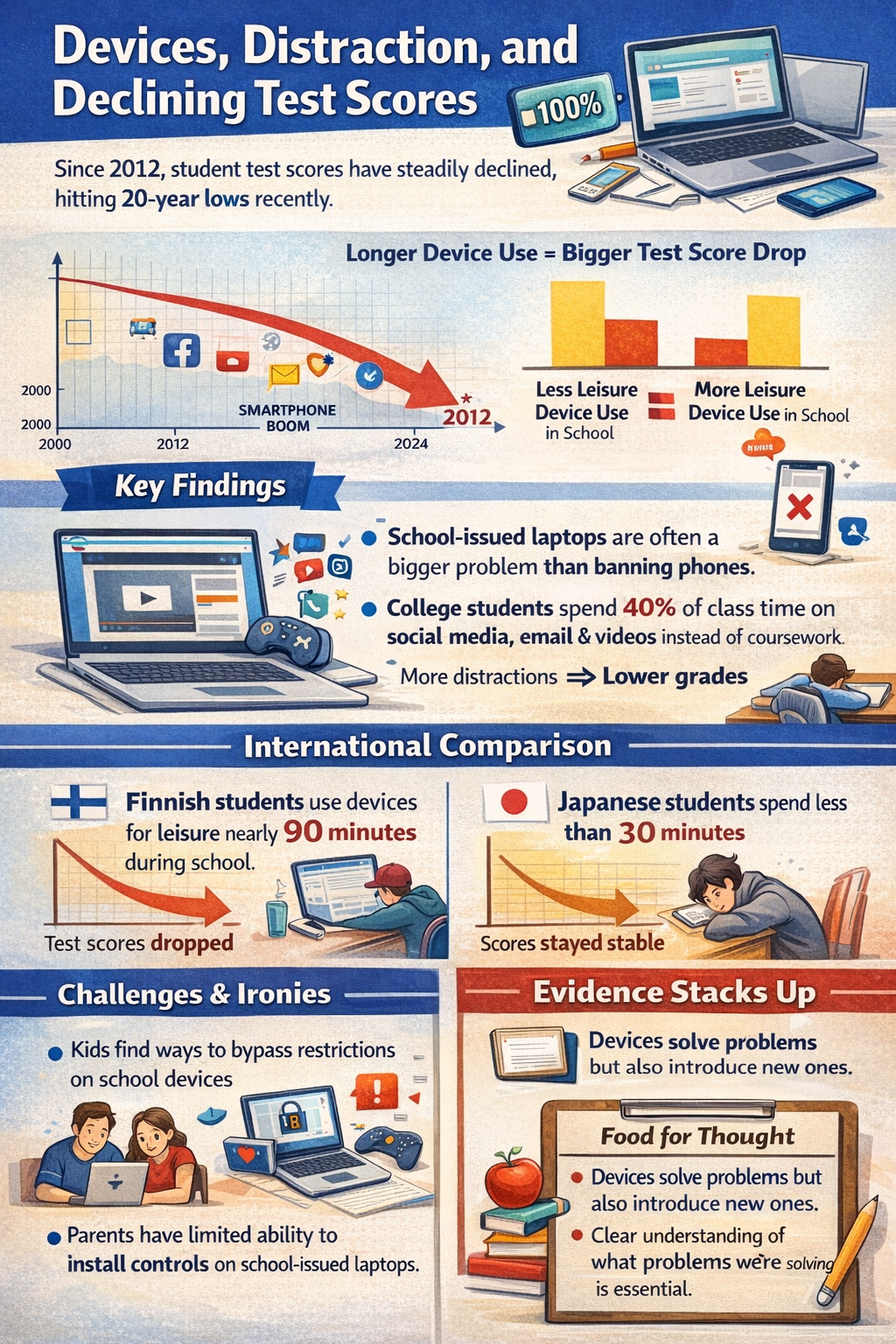
Psychologist Jean M. Twenge argues that school-issued laptops and tablets with unrestricted internet access are contributing to declining student test scores. American standardized test scores began falling around 2012 and reached 20-year lows in 2023-2024. While COVID-19 disruptions played a role, the decline predates the pandemic, coinciding with widespread smartphone adoption and the proliferation of school-issued devices.
Twenge's research found that countries where students spend more time using devices for leisure during school hours experienced larger drops in test scores than countries with less device use. Finnish students, who use devices for non-academic purposes nearly 90 minutes during school days, saw scores plummet between 2006 and 2022. Japanese students, spending less than 30 minutes on leisure device use, maintained relatively steady performance. A study of college students found they spent nearly 40 percent of class time on social media, email, and videos, with more distraction correlating to lower exam scores.
Twenge notes that parents typically cannot install parental controls on school-issued devices, yet schools place responsibility for supervision on parents. She advocates for significantly restricting device functionality, reducing device-dependent assignments, allowing parents to opt out of school devices, or potentially eliminating school devices entirely. Research she cites shows reading on paper produces better comprehension than digital reading, and students taking handwritten notes are 58 percent more likely to earn A's than those typing notes.
The central question is whether the educational benefits of ubiquitous device access justify the apparent costs in student attention and academic performance.
Read the full opinion piece in The Salt Lake Tribune
Commentary
Correlation vs. Causation: The article presents correlation between device use and declining test scores, but establishing causation is more complex. Multiple factors changed simultaneously around 2012: smartphone adoption, social media maturation, changes in educational standards and testing, shifts in teacher training and pedagogy, and broader social changes. Isolating device use as the primary driver requires controlling for these confounding variables, which cross-national comparisons attempt but cannot fully achieve.
What Problems Do Devices Solve?: Before concluding devices should be eliminated or severely restricted, it's worth examining what problems they were introduced to solve. Devices can provide: instant access to information and research materials, differentiated instruction through adaptive learning software, accessibility accommodations for students with disabilities, reduced costs for textbooks and materials, preparation for technology-dependent workplaces, and equitable access to computing resources for students without home devices. Whether these benefits outweigh the attention costs is an empirical question, not an obvious answer.
The Finland Paradox: Finland's dramatic decline is presented as evidence against device use, but Finland's education system changed in multiple ways during this period. Teacher authority and curriculum structure shifted, homework expectations changed, and education policy underwent significant reforms beyond just technology adoption. Additionally, Finland's previous exceptional performance may have been partially explained by factors (small, homogeneous population; high social trust; strong teacher unions) that are difficult to replicate and may be eroding for reasons unrelated to devices.
Selection Effects and Self-Report Data: Studies relying on student self-reports of device use during school may capture selection effects. Students who are already disengaged or struggling academically may be more likely to use devices for entertainment during class, rather than device use causing their disengagement. Longitudinal studies tracking the same students before and after device adoption would provide stronger evidence.
The Handwriting vs. Typing Research: The finding that handwritten notes correlate with better academic outcomes is well-replicated, but the mechanism matters. Students typing notes often transcribe verbatim without processing, while handwriting forces summarization and synthesis due to speed limitations. Teaching students to take better typed notes (summarizing rather than transcribing) might achieve similar outcomes. The question is whether the medium itself is critical or whether it's a proxy for cognitive processing depth.
Measurement Issues: Standardized test scores measure a narrow band of cognitive skills. If devices trade lower performance on memorization and focused attention tasks for higher performance on information synthesis, collaborative problem-solving, or digital literacy, standardized tests might show decline even if overall educational outcomes improve. The value judgment about which skills matter more is separate from the measurement question.
The Restriction Feasibility Problem: Even if we accept that unrestricted device use harms learning, implementing effective restrictions faces technical and political challenges. Tech-savvy students routinely bypass restrictions. Teachers need devices for instruction and may resist restrictions that make their jobs harder. Parents expect schools to prepare students for technology-dependent workplaces. Creating genuinely locked-down devices while maintaining educational functionality is non-trivial.
Alternative Explanations for Score Declines: Test score declines could reflect: changing student demographics and enrollment patterns, increased testing of previously excluded populations (students with disabilities, English language learners), teaching-to-the-test fatigue after decades of high-stakes testing, reduced emphasis on rote memorization as educators prioritize different skills, or broader cultural shifts in attention and focus independent of school device policies.
The Paper vs. Digital Reading Question: Research consistently shows better comprehension for paper reading, but this may be partly explained by reader expectations and habits. People approach digital text differently, skimming rather than deep reading. Training students in focused digital reading strategies might close this gap. Additionally, digital text offers affordances paper lacks: searchability, embedded multimedia, real-time collaboration, and accessibility features.
Economic and Equity Considerations: Eliminating school devices would increase inequality. Students from affluent families would still have home access to computers, internet, and educational software, while students from lower-income families would not. School devices were partly adopted to level this playing field. Any policy restricting school devices needs to address how students without home technology access will complete modern educational requirements.
The ChatGPT Dimension: The article mentions students using ChatGPT to complete assignments, which is a legitimate concern but represents a different problem than distraction. This reflects the challenge of assessing learning when students can outsource cognitive work to AI. This problem exists regardless of device policies, since students have home access to AI tools.
What Would Success Look Like?: If the goal is improving test scores, restricting devices might help. If the goal is preparing students for knowledge work in a technology-saturated environment, unrestricted devices might be necessary despite attention costs. If the goal is promoting wellbeing and mental health, device restrictions might be critical. Schools need clarity about which outcomes they're optimizing for, since these goals sometimes conflict.
The Honest Accounting: The article's core suggestion is worth taking seriously: be clear about what problems devices solve, be honest about what problems they create, and make explicit tradeoffs rather than assuming devices are unambiguously beneficial. This requires better measurement of both costs and benefits, acknowledging uncertainty about causation, and recognizing that the optimal policy might vary by age, subject matter, and student population rather than being universal.